
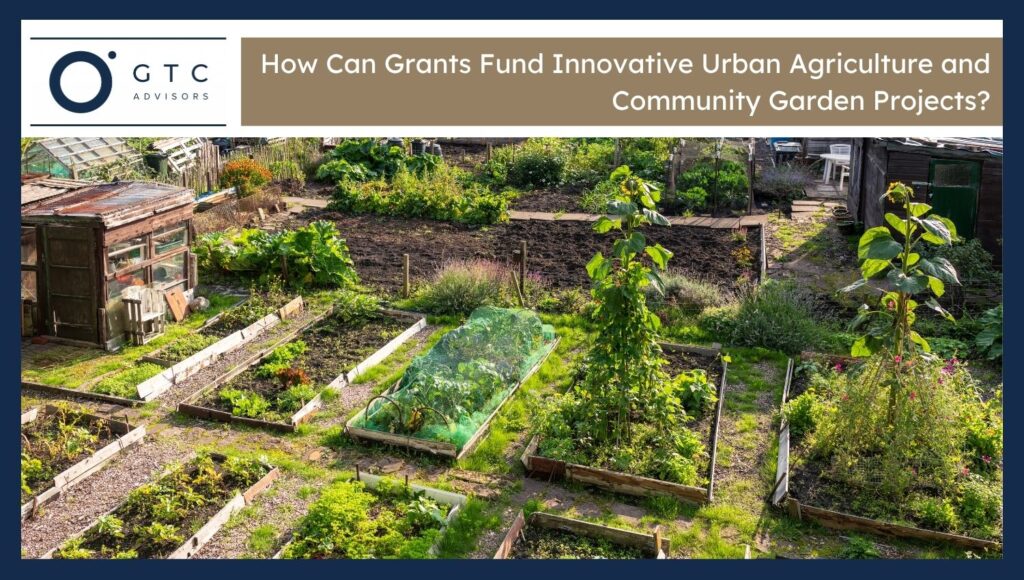
Grants support testing and refining urban agriculture and community gardening models to address specific growing issues. Expensive technology isn’t always necessary for innovation. It also involves making limited space more productive, using water more efficiently, managing nutrients more effectively, sharing garden resources, or simplifying garden maintenance. Incentives include vertical farming, rooftop farming, modular beds, controlled-environment systems, and community-managed infrastructure. Organizations should be able to identify the issue the innovation aims to solve, evaluate whether it contributes to better outcomes, and determine its real-world impact. A small pilot helps assess whether the model needs adjustment, expansion, or discontinuation.
Which Innovations Can Help Urban Growers Produce More Food in Limited Space?
Here are the 5 innovations that can help urban growers produce more food in Limited Space:
- Vertical and Stacked Growing: Vertical racks, towers, trellises, and stacked beds improve space use for growers. Projects should assess whether these configurations increase production while maintaining easy access to crops and work.
- Rooftop Food Production: Rooftops offer additional growing space in urban areas where ground space is scarce. Before starting food production, projects should evaluate structural capacity, safe access, water supply, wind exposure, heat, long-term site control, drainage, and more.
- Container and Modular Growing: These are great for unsuitable sites, contaminated soil, and where installing permanent structures is not feasible. These systems also help organizations modify layouts as needs expand.
- Indoor and Controlled-Environment Production: This involves indoor growing, hydroponics, aquaponics, and climate-controlled production, used to overcome limitations such as space, growing seasons, soil contamination, and unreliable production. Weigh the benefits of granted pilots against utility, technical, and maintenance needs.
- Multi-Use Urban Space: Underused courtyards, school property, shared lots, and institutional properties are used for food production. Projects focus on developing these areas into productive spaces, considering access, site restrictions, shared use, and continued functioning.
Which Innovations Can Reduce Water, Soil, Waste, or Climate Constraints?
Here are 5 innovations that can reduce water, Soil, Waste, or Climate Constraints:
- Water-efficient irrigation and recirculation: Drip irrigation, water-based scheduling, water capture, and recirculating systems reduce water demand. Projects should evaluate whether these methods conserve water without compromising reliable crop production.
- Soilless or Contained Growing: Raised beds, contained systems, hydroponics, and other growing-media options address poor, compacted, contaminated, or unavailable soils. Plans should address nutrient management, growing-media replacement, disposal, and recurring nutrient inputs.
- Compost and Nutrient-Recovery Loops: Linking local waste streams with local needs through composting and organic-waste reuse, as well as nutrient recovery. Pilots need to assess whether these practices reduce waste or procured inputs and whether they provide a reliable nutrient source for production.
- Season Extension and Microclimate Management: A variety of structures and methods extend the growing season or stabilize production, including high tunnels, shade structures, wind protection, protected beds, and passive heat management. Projects must be tested for effectiveness in local weather conditions.
- Low-Cost Monitoring and Automation: Sensors, timers, simple monitoring systems, and selective automation address specific water-use, labor, climate-control, and reliability issues. Funds should target technology that is clearly proven to provide an operational advantage, not add complexity without benefit.
How Can Community Gardens Innovate Without Turning Into High-Tech Urban Farms?
Community gardens innovate with low-cost tools, such as better shared plantings, accessible designs, and more effective garden management. Grants cover shared tools, propagation areas, compost systems, wash stations, storage space, irrigation, and accessible work areas to overcome common bottlenecks. Flexible plot sizes, communal growing beds, seed libraries, shared seedlings, and cooperative purchasing also help involve more people and reduce costs. Innovation also includes changing plot assignments, maintenance rotations, volunteer schedules, and seasonal onboarding to address recurring issues. The primary aim is to improve food production or garden management while maintaining a model that is simple and easy for community members to use.
How Should Organizations Choose Between a Low-Tech and High-Tech Growing Model?
Organizations start with the constraint they face in their growth and choose the simplest model that solves the problem at hand. A simple solution is the optimal solution for layout, access, scheduling, or water management problems. Use a more technical system only if it provides a distinct benefit not achievable with simpler systems. Comparisons should include purchase price, utilities, replacement parts and consumable inputs, specialist labor, maintenance, and failure recovery. Evaluate available skills, water and power supplies, drainage, ventilation, weather exposure, and site security. The selected garden system is easy for the average community garden participant to understand and maintain. The best option balances performance, affordability, reliability, maintainability, and community needs.
How Should a Grant-Funded Pilot Be Designed to Test the Innovation Rather Than Just Build It?
A grant-funded pilot requires a well-defined hypothesis that specifies the improvement the innovation will produce. A project compares a new layout’s ability to produce more garden space per square foot, use less water per pound of produce, produce more in a longer growing season, or provide more shared garden resources. Organizations need a standard, whether it’s current performance, a traditional growing bed, or a past season. Start testing on a manageable scale before buying large equipment or expanding the entire site. Teams should maintain the same conditions as much as possible and document any failures, downtime, repairs, water issues, pest issues, and participant confusion. Review points are used to decide whether to continue the pilot, modify the design, redesign, or terminate the pilot. Recording operating methods makes it easier to replicate successful results.
When Should an Urban Agriculture Pilot Be Scaled, Adapted, or Stopped?
Scale up the pilot when evidence shows repeatable improvement, and the team can manage a larger operation. Adaptation is warranted when the basic idea is sound, but the current design causes unnecessary equipment issues, crop selection problems, staffing challenges, training needs, irrigation issues, or participant usage issues. Discontinue a project if expenses, failures, or labor requirements consistently exceed expected benefits, or if adoption is low or production is poor. Organizations must determine what conditions contributed to the pilot’s success and whether those conditions exist elsewhere before expanding to another site. They must also record assumptions that proved unsuccessful and useful information to prevent future projects from making similar mistakes. Organizations implement the successful element rather than the entire innovation when only part of it is valuable.

George C. Tagg, Jr.
George serves as a trusted counsel to business leaders, non-profit executives, and management teams. George is a licensed attorney with a master’s in international affairs and over 20 years’ experience in the U.S. Congress, Department of State, Department of Defense, global public policy, and political campaigns.