
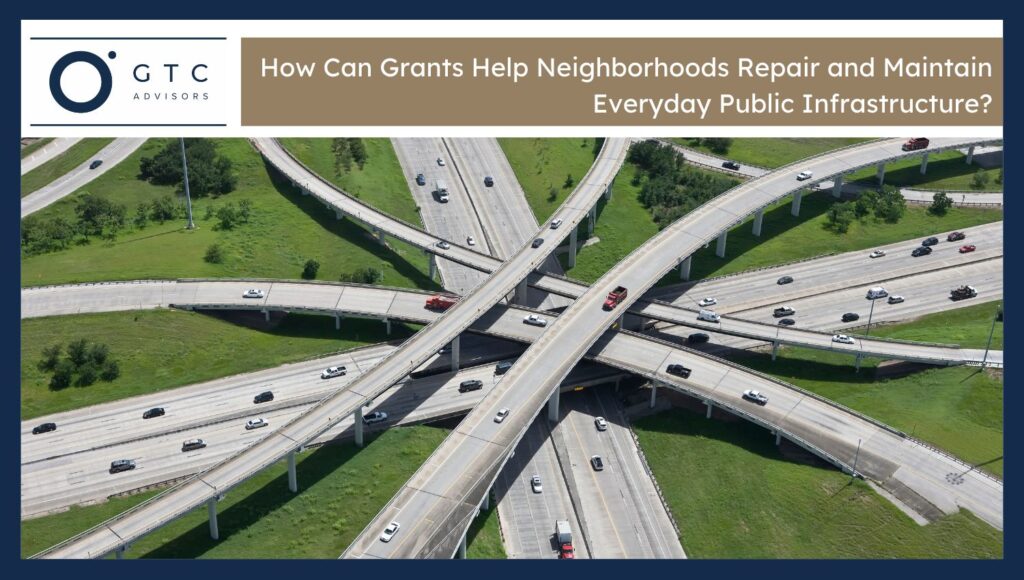
Grants help neighborhoods revitalize public facilities that are in poor condition or no longer functioning. They support repairs, replacements, and coordinated construction of shared neighborhood assets. These projects improve the safety and functionality of sidewalks, drainage, public facilities, basic facilities, and paved surfaces. Funding goes to municipalities, nonprofits, community groups, business districts, and community partners to address specific infrastructure issues. A project targets damaged sidewalks, frequent drainage issues, malfunctioning public fixtures, or crumbling paved connections. This work isn’t about public safety strategy, urban greening, housing, placemaking, or general community development planning; it’s about routine maintenance of the defined asset, how to make it work. All projects start with a physical asset that needs attention. It then progresses to failure diagnosis, repair decisions, construction coordination, access planning, and long-term maintenance. The goal of a successful grant project is to deliver neighborhood infrastructure that functions reliably and is easy to maintain after the grant ends.
Which Failing Public Infrastructure Asset Should the Grant Be Designed to Fix?
A good infrastructure project pinpoints the exact asset to fix. The organization specifies which part of the sidewalk, curb line, drainage, paved connection, public-service fixture, or small facility is concerned. It then talks about the functional problem. This results in cracked or settled surfaces, frequent ponding, broken fixtures, deteriorated pavement, blocked connections, and frequent repairs. Inspections, maintenance records, service requests, asset inventories, site photographs, and repair histories determine the problem’s extent. This evidence also indicates whether the problem is one-time or recurring. Organizations distinguish physical infrastructure failures from project priorities. Public-safety projects include crime reduction and emergency response. Urban-greening projects include vegetation and green stormwater systems. Public space design and placemaking need to be a different focus in inclusive design. The grant proposal therefore specifies a particular functional outcome. It describes which asset will be more reliable, durable, connected, usable, or easier to maintain after the work is completed.
Which Small-Scale Public Infrastructure Repairs and Replacements Can Grant Funding Support?
Here are the 6 Small-Scale Public Infrastructure Repairs and Replacements That Can Receive Grant Funding Support:
- Grants fund small- to medium-scale projects: These grants help with enhancements to shared physical infrastructure. Funding depends on eligible work, which is subject to the funding program and asset ownership. Projects address degrading surfaces, drainage problems, damaged fixtures, and basic public facilities. The proposed work should be directly related to the current state and the day-to-day use of the asset.
- Sidewalks and Pedestrian Connections: Grants are available to repair deteriorated sidewalks, paths, curb edges, and short connecting routes. Cracked, uneven, and settled paving, along with damaged transitions between the curb and sidewalk, hinder typical neighborhood mobility. They become physically connected again when they are repaired or replaced. Projects target broken infrastructure, not a larger streetscape makeover.
- Conventional Drainage and Hardscape: Funding covers grading repairs, drainage inlets, curbs, pavement edges, and conventional stormwater elements. Poor drainage and surface settlement damage nearby public infrastructure. Projects target the physical causes, such as broken inlets, clogged drainage connections, and worn hardscape. Green stormwater systems, including rain gardens and bioswales, are in the separate urban-greening scope.
- Public-Services Fixtures: Broken or missing public fixtures decrease the value of shared neighborhood areas. Grants are available to replace or repair waste receptacles, bicycle racks, drinking fountains, and service signage to ensure they function properly. The project seeks to determine which fixtures are no longer performing the function for which they were built. Replacement means using long-lasting equipment that is appropriate to the site and maintenance resources.
- Basic Public Facilities and Service Structures: Small public facilities need repairs before they will resume normal operations. Restrooms, service kiosks, small structures, and utility-adjacent features are eligible projects. Work includes repairing failures, worn parts, and physical damage that disrupt normal service. The proposed improvements are intended as a restoration project, not a larger project.
- Paved Civic Surfaces and Forecourts: Grants are available to rehabilitate deteriorated paved civic surfaces, forecourts, loading edges, service areas, and other common hardscape. Cracking, settlement, surface deterioration, and pavement edge issues are common maintenance needs. Funding addresses the physical condition of these surfaces and returns them to their intended use. The project is still an infrastructure project and not a placemaking or programming project.
When Should a Project Repair, Replace, or Reconfigure Existing Infrastructure?
Repair infrastructure with targeted repairs where deterioration is limited and the underlying infrastructure is sound. Revert to normal operation without replacing parts that are still operating normally. Replacement is appropriate if failures persist after repeated repairs, the product or material is at the end of its life, or the system cannot perform its basic function with the existing system. Reconfiguration is solving a different problem. Failure is caused by the existing alignment, dimensions, drainage arrangement, circulation, or fixture placement, which fail repeatedly. In those cases, the same configuration is reproduced, perpetuating the problem. Organizations perform life-cycle costing when choosing an approach. The first cost matters, but recurring repair costs, probable service life, and maintenance costs also factor into the decision. This cost is incurred for an inexpensive repair that keeps failing. Projects must also have a well-defined scope. No sidewalk or drainage repair should be required for an entire streetscape, greening, placemaking, or neighborhood redesign. The chosen intervention should fix the documented physical problem without making other work irrelevant.
How Should Utilities, Drainage, and Surface Work Be Coordinated So One Repair Does Not Undo Another?
Project teams map the locations of buried and overhead utilities, drainage routes, pavement layers, curbs, foundations, and service connections. This review identifies components that cross or rely on the repair area. Subsurface issues are addressed before completing surfaces. Pre-paving and prepaving structural tasks include utility connections, drainage correction, base repairs, and structural tasks. Excavation later destroys newly built improvements. Project teams also interface with utility companies, public works, transportation, property owners, and other responsible entities. Reviewing planned work helps prevent reopening recently repaired areas for planned maintenance. Teams coordinate excavation and restoration activities where possible and appropriate. Trenching, base repair, drainage correction, and surface restoration minimize repetitive disturbance and mobilization. Teams also store constructed work for later phases of construction. Equipment movement, material deliveries, fixture foundations, and utility connections follow an agreed sequence. The construction schedule records which components depend on earlier work. This creates a practical order for procurement, installation, inspection, and final restoration.
How Can Construction Preserve Essential Neighborhood Access While Repairs Are Underway?
The first step in construction planning is to determine which routes and services will continue to provide access. Project teams survey areas around the work site for entrances, residences, businesses, delivery points, transit connections, and public facilities. They develop construction plans to minimize unnecessary disruptions. Partial closures, temporary routes, and alternate access create partial traffic flow while repairs are made. Other neighborhood daily activities are also reflected in work schedules. Teams consider deliveries, school activity, business hours, transit periods, seasonal needs, and other predictable needs. Temporary signage clearly identifies routes of movement and entrances during each phase of construction. The signs help residents, visitors, employees, and providers navigate the evolving environment. Completed sections re-open as soon as they are working, not because other work is going on elsewhere. The uncompleted infrastructure remains unused until dependent components are available. Work such as drainage, structural layers, curing, and fixtures must be completed. This ensures access to the infrastructure while keeping users from experiencing incomplete or unreliable infrastructure.

George C. Tagg, Jr.
George serves as a trusted counsel to business leaders, non-profit executives, and management teams. George is a licensed attorney with a master’s in international affairs and over 20 years’ experience in the U.S. Congress, Department of State, Department of Defense, global public policy, and political campaigns.